Closed-Cell Spray Foam Insulation
The densest, highest-performing spray foam available — rigid closed-cell foam insulates, air-seals, and blocks moisture in a single application, making it the right call anywhere cavity space is tight or water is a concern.
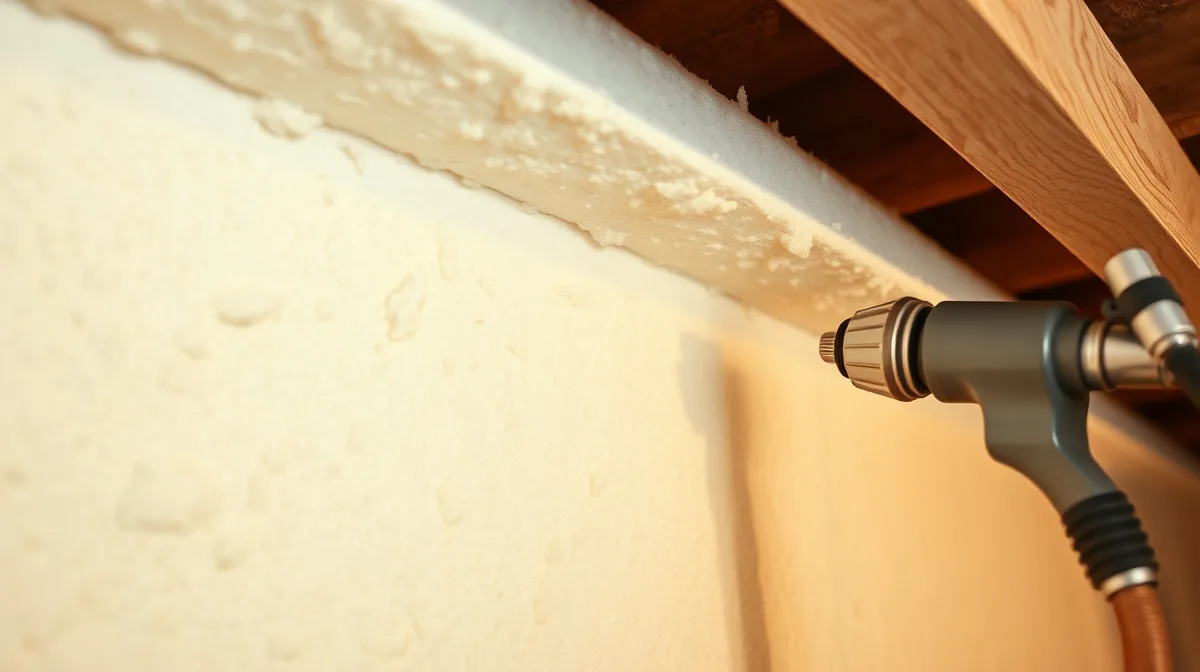
Closed-cell spray foam is a rigid, high-density material that expands to roughly 30-40 times its liquid volume and cures into a hard, load-bearing surface. Its tightly packed cell structure traps gas rather than air, which is why it delivers R-6 to R-7 of insulating value per inch — nearly double what open-cell foam or fiberglass batts provide in the same cavity depth. That density is also why closed-cell foam does something no other insulation material does on its own: it insulates, air-seals, and acts as its own vapor and moisture barrier in one application, whether it's sprayed by a crew serving a new-construction site, an existing home retrofit, or a commercial building. Traditional insulation materials like fiberglass and cellulose only slow heat transfer — they do nothing to stop air leakage, and they rely on a separate vapor barrier to manage moisture. Closed-cell foam handles all three jobs at once, which is the core reason contractors specify it for the most demanding parts of a building envelope.
Because closed-cell foam reaches such a high R-value in a thin layer, it's the practical choice anywhere cavity space is limited — rim joists, crawl space walls, and tight retrofit assemblies — and anywhere moisture is a real risk, including below-grade walls, crawl spaces, and exterior sheathing in humid or wet climates. It also adds meaningful structural racking strength to a wall assembly once cured, a benefit fiberglass, cellulose, and even open-cell foam don't offer. That combination of performance, moisture resistance, and structural contribution is why closed-cell is the default recommendation for exterior walls, crawl spaces, rim joists, and any application near ground contact or water exposure, nationwide, regardless of property type or climate zone. Whether the project is a new-construction wall cavity before drywall goes up, an existing home's crawl space getting encapsulated, or a metal building fighting condensation on the underside of the roof, closed-cell foam's density is what makes it the right material for the job rather than a premium upsell.
Why property owners choose it
- Delivers the highest R-value per inch of any common insulation material, at R-6 to R-7, so you get full performance in shallow or space-constrained cavities.
- Acts as its own vapor and moisture barrier, which makes it the right choice near foundations, crawl spaces, and other water-exposed assemblies without adding a separate membrane.
- Adds real structural racking strength to walls once fully cured, stiffening the assembly against wind and seismic loads.
- Air-seals and insulates in a single application, closing the gaps and penetrations that fiberglass and cellulose simply can't stop.
- Resists moisture intrusion and inhibits mold growth by not absorbing water the way fibrous insulation does.
- Holds its R-value over time instead of settling, sagging, or losing loft the way blown-in and batt insulation can.
Why Density and R-Value Per Inch Matter
Closed-cell spray foam's cell structure is what sets it apart. Instead of the open, interconnected cells found in lighter foam and fibrous insulation, closed-cell foam cures into a rigid matrix of sealed cells that trap an insulating gas. That structure is what pushes R-value to 6-7 per inch — meaning a 2-inch application in a rim joist or crawl space wall can outperform several inches of fiberglass batt, without eating into livable or usable space. For retrofit projects where wall or floor cavities are already framed and fixed in depth, that efficiency is often the deciding factor over open-cell foam or traditional insulation.
The density that produces the R-value also produces the rigidity. Once cured, closed-cell foam is a hard, load-bearing material rather than a soft, springy fill. That's why it's often specified in wall assemblies where added racking strength helps a structure resist lateral wind or seismic loads — a performance benefit that has nothing to do with thermal resistance but matters a great deal to builders and structural engineers on new-construction and heavy-retrofit jobs. It's also why closed-cell foam holds its performance over time: unlike fibrous insulation that can settle, sag, or lose loft over the years, a cured closed-cell application keeps its shape and its R-value for the life of the building.
- R-6 to R-7 per inch — roughly double open-cell foam's R-3.5-3.7 per inch
- Rigid, load-bearing cell structure once fully cured
- Thinner application achieves the same or better performance than thicker fibrous insulation
- Adds measurable racking strength to framed wall assemblies
A Built-In Moisture and Vapor Barrier
Fiberglass and cellulose absorb moisture. Given enough exposure to humidity, ground water, or condensation, they lose R-value, compress, and become a breeding ground for mold — problems that show up most often in crawl spaces, basements, and exterior wall cavities near grade. Closed-cell spray foam doesn't have that failure mode. Its sealed-cell structure resists water absorption and functions as a vapor barrier in its own right, which is exactly why it's the standard recommendation for crawl space walls, below-grade applications, and any assembly where moisture exposure is a realistic long-term concern.
That built-in vapor control also simplifies the assembly. Instead of installing a separate vapor barrier membrane and hoping every seam and penetration is sealed correctly, closed-cell foam handles insulation, air-sealing, and vapor control in the same pass. For crawl space encapsulation projects specifically, that means fewer failure points and a wall system that's doing double duty — keeping conditioned air in and ground moisture out — without relying on a second material to get it right. It's worth being direct about off-gassing here too: the VOC release that concerns some homeowners happens during curing, not after. A properly installed, fully cured closed-cell application is inert and safe. The complaints that make headlines almost always trace back to improperly mixed or improperly cured jobs, or bad DIY kits — which is the strongest argument for hiring a licensed, experienced crew rather than a reason to avoid the material.
- Resists water absorption instead of holding moisture like fibrous insulation
- Functions as its own vapor barrier without a separate membrane
- Standard specification for crawl space walls and below-grade assemblies
- Reduces the number of failure points in moisture-sensitive wall systems
Where Closed-Cell Foam Is the Right Call
Closed-cell foam isn't always the cheaper option compared to open-cell, and it doesn't need to be used everywhere in a building — but there are specific spots where it's the clear right choice. Rim joists and band joists are a prime example: this narrow perimeter band between the foundation and first floor is one of the highest-leak-rate details in most buildings, and closed-cell foam's high R-value per inch fits the shallow cavity perfectly while sealing air leaks that fiberglass batts never fully stop. Crawl spaces are another, both for the moisture-barrier properties and because closed-cell foam holds up in a damp, low-clearance environment where fibrous insulation would eventually fail.
Exterior walls, especially in new construction, commercial buildings, and pole-barn or metal-building applications, round out the list — anywhere the combination of high R-value, air-sealing, moisture resistance, and structural contribution is worth the higher material cost per board foot. On a national scale, that makes closed-cell foam the default recommendation any time cavity space is tight, water exposure is a factor, or the wall assembly benefits from added rigidity, regardless of whether the property is a new build, an existing home retrofit, or a commercial structure. A licensed crew evaluating your project will typically walk the space, identify which cavities call for closed-cell versus open-cell foam, and put together a firm, itemized estimate rather than a one-size-fits-all quote — because the right foam for a rim joist isn't necessarily the right foam for an interior partition wall.
- Rim joists and band joists — high-leak, shallow-cavity detail
- Crawl space walls as part of a full encapsulation approach
- Exterior walls in new construction and commercial builds
- Metal buildings and pole barns needing condensation control
- Any assembly where cavity depth is limited but performance can't be
Ideal for
- Crawl spaces and below-grade walls where moisture control matters as much as R-value
- Rim joists and band joists, where a thin, high-performing layer is needed in a shallow cavity
- Exterior walls in new construction or gut retrofits where structural stiffening is a bonus
- Homes and buildings in humid, coastal, or flood-prone climates where a built-in moisture barrier reduces risk
- Any tight cavity — additions, retrofits, pole barns — where there isn't room for a thick insulation layer
What affects the cost
Closed-Cell Foam questions, answered
Closed-cell spray foam typically delivers R-6 to R-7 per inch, roughly double the R-value per inch of open-cell foam and well above fiberglass or cellulose. That density lets it hit strong insulation performance in a thinner application, which matters most in shallow or space-constrained cavities.
Closed-cell foam is highly resistant to water absorption and acts as its own vapor barrier, which is why it's the standard choice for crawl spaces and below-grade walls. It isn't a substitute for proper drainage or grading, but it won't hold moisture or degrade the way fibrous insulation does when exposed to dampness.
Both areas combine tight cavity space with real moisture exposure — exactly where closed-cell foam's high R-value per inch and built-in vapor barrier properties matter most. Rim joists in particular are a commonly missed, high-leak-rate detail that closed-cell foam seals and insulates in one pass.
Yes. Once fully cured, closed-cell foam is a rigid, load-bearing material that adds measurable racking strength to a framed wall assembly, helping it resist wind and seismic loads. That's a structural benefit on top of its thermal and moisture-control performance.
For applications near moisture, in tight cavities, or where structural contribution matters, closed-cell foam's performance advantages typically justify the higher material cost per board foot. For interior walls or sound-dampening applications without those constraints, open-cell foam is often the more cost-effective choice — a licensed crew can evaluate your specific project and give you a firm, free estimate.
Closed-Cell Foam done right, by a dedicated spray foam crew
Closed-Cell Foam isn't a commodity — the result depends entirely on how carefully it's planned and applied for your specific space. We assess what your project actually needs, prep the area properly, and apply to the depth and product your goals require, so the work delivers the comfort and savings it's supposed to. No shortcuts, no builder-grade rush.
We serve homeowners, builders and general contractors, and commercial property owners nationwide. Every job starts with a free, no-pressure assessment.
Just as important, we treat your building as a system. Air-sealing, insulation product choice, and ventilation all interact — getting one right while ignoring the others leaves comfort and savings on the table. When we scope your closed-cell foam, we look at how it fits the whole picture, so the finished result performs the way it should and actually lowers the bills you feel every month.
Free assessment
We evaluate your space and give you a clear, itemized quote with no pressure.
Expert application
We prep and spray your closed-cell foam to spec — clean and on schedule.
Comfort you can feel
A more comfortable, energy-efficient space and honest advice on what your project needs.
Related services
Ready for a free closed-cell foam quote?
Tell us about your project and we'll put together a clear, no-pressure spray foam insulation quote — residential or commercial, anywhere in the country.