Wall Spray Foam Insulation (New & Existing Walls)
Spray foam wall insulation for open stud cavities in new construction and injection-foam retrofits into already-finished walls — no drywall demo, no re-siding, just a tighter, quieter, better-insulated wall.
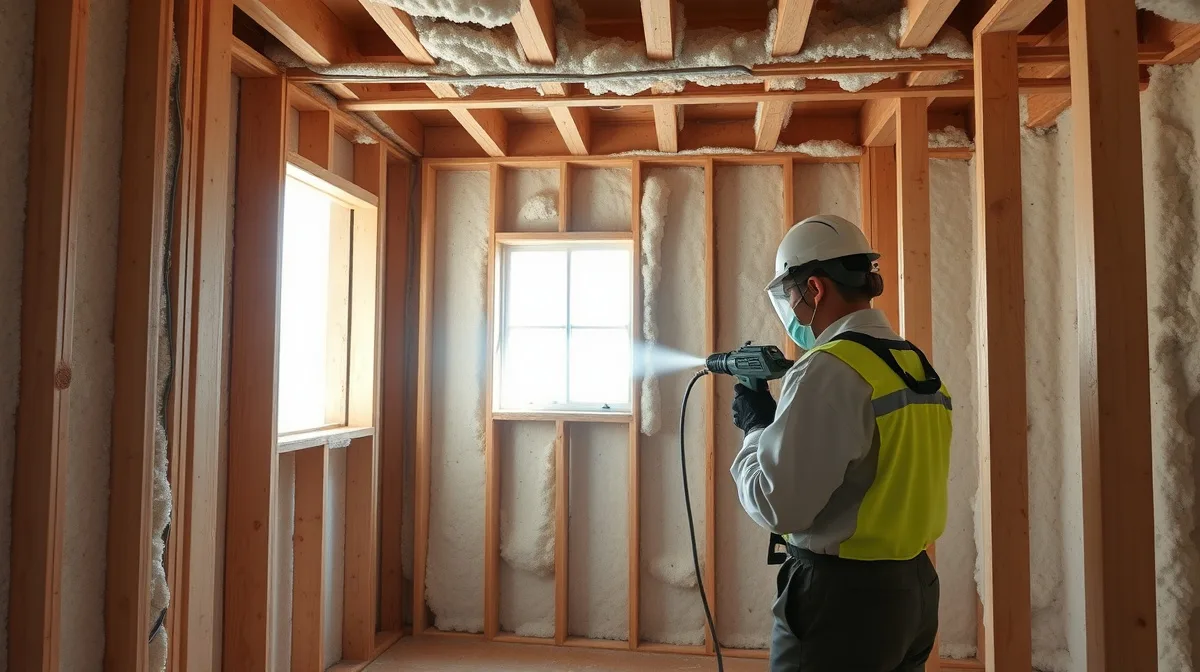
Walls lose energy two ways: through the insulation material itself and through the air that leaks around it. Fiberglass batts slow heat transfer when they're installed correctly and stay put, but they don't stop air movement, and they rarely fit tightly around outlets, top plates, corner studs, and plumbing runs. Spray foam solves both problems in the same pass. In open stud cavities it expands to fill every irregular gap around wiring and framing, insulating and air-sealing the wall in one application. That single-step approach is why spray foam consistently outperforms batt insulation in the same wall cavity, even before accounting for its higher R-value per inch.
We install wall spray foam insulation two different ways depending on the project. In new construction, foam is sprayed directly into open stud cavities after framing and rough-in inspection but before drywall goes up — the crew's only shot at that wall before it's closed in. In existing homes, walls are already finished, so we use injection foam: small access holes, foam pumped into each cavity under pressure, holes patched when the foam has expanded and set. Beyond R-value, homeowners consistently notice two side effects first — quieter rooms and fewer drafts near outlets and baseboards. We serve residential, builder/GC, and commercial projects nationwide with licensed, insured installation crews. Request a free estimate to find out which wall approach fits your project.
Why property owners choose it
- Air-seals every wall cavity in a single application, closing the gaps around wiring, plumbing, and framing that fiberglass batts leave open.
- Covers both project types — open-cavity spraying for new construction before drywall goes up, and injection retrofit for existing finished walls with no demo required.
- Delivers higher R-value per inch than fiberglass or cellulose in the same stud cavity depth, whether it's a 2x4 or 2x6 wall.
- Reduces sound transmission through interior and exterior walls by filling voids that batts and gaps leave for noise to travel through.
- Eliminates cold spots and drafts along exterior walls, evening out room-to-room temperatures instead of leaving perimeter rooms colder.
- Retrofit injection work uses small patched access holes instead of tearing out drywall, removing trim, or stripping siding.
New Construction: Spraying Open Wall Cavities Before Drywall
New-construction wall insulation is the more straightforward of the two approaches because the cavity is wide open. Once framing is complete and rough-in inspection has passed, foam is sprayed directly onto the sheathing and into each stud bay before insulation inspection and drywall. It expands to fill the full depth of the cavity around outlet boxes, wiring runs, and plumbing penetrations — obstacles that routinely leave gaps and compression points in cut-to-fit batt insulation. Open-cell or closed-cell foam can be used depending on the wall's exposure and the builder's target R-value per inch, and a 2x6 wall holds more foam volume than a 2x4 wall, which affects both material cost and finished R-value.
For builders and GCs, a fully sprayed wall assembly is also a building-science decision, not just a comfort upgrade. A tighter envelope improves blower-door test results and supports IECC energy code compliance, and it's one of the arguments builders use to justify smaller, less expensive HVAC equipment on new builds. This work is scheduled tightly around the framing and rough-in timeline — it's the only window before the wall is closed in, so coordinating spray foam alongside a new-construction project from the framing stage on keeps the schedule moving instead of adding a delay.
- Sprayed after framing and rough-in, before drywall closes the wall
- Full-depth fill around outlets, wiring, and plumbing penetrations
- Open-cell or closed-cell selected by wall exposure and R-value target
- Supports IECC energy code compliance and smaller HVAC sizing
Retrofit Injection Foam: Insulating Finished Walls Without Demo
Most existing homes can't have their walls opened up just to add insulation, which is why retrofit wall insulation uses injection foam instead of spray application. A technician drills a small access hole into each stud bay — from the exterior siding or from inside, depending on the wall assembly — and injects foam under pressure. The foam expands to fill the cavity around any existing wiring or old insulation already in place, then the access holes are patched and sealed to blend with the existing wall finish. No drywall demo, no interior rebuild, and in most cases no re-siding of the exterior.
This is the right call for older homes with wall cavities that were never insulated, homes where the original fiberglass has settled and left gaps at the top of the cavity, and additions built to a lower insulation standard than the rest of the house. It's also far less disruptive and less expensive than a gut-and-rebuild approach to the same wall. Because access and patch work vary by siding type — vinyl, wood lap, brick, and stucco each require a different injection and patch method — a wall retrofit estimate is scoped to the home's actual exterior finish rather than a flat per-square-foot number.
- Small drilled access holes per stud bay, patched and sealed after injection
- Expands around existing wiring and any old insulation already in the cavity
- No drywall demo and, in most cases, no exterior re-siding
- Method and patch work vary by siding type — vinyl, wood, brick, stucco
Noise Reduction and Draft Elimination — the Secondary Payoff
R-value gets top billing, but most homeowners notice two other things first: the house is quieter, and the drafts are gone. Fiberglass batts leave small gaps at the edges of every cavity, and sound travels through those gaps as easily as air does. Spray foam and injection foam fill the entire cavity, so both airborne sound and drafty air movement lose the path they were using to get through the wall. That makes it a practical upgrade for exterior walls facing street noise, shared walls next to an attached garage, and interior partition walls around bedrooms, bathrooms, or a home office.
The comfort difference shows up as evenly heated and cooled rooms instead of a house where the rooms on the north or street side always run colder. Exterior walls insulated with spray foam hold a more consistent interior surface temperature, which cuts down on the "cold wall" feeling near exterior-facing furniture and seating. Drafts near outlets, switch plates, and baseboards on exterior walls — one of the most common comfort complaints in older homes — are one of the first things to disappear once the wall cavity behind them is fully sealed.
Ideal for
- New-construction builders and GCs who want walls sprayed after framing and rough-in but before drywall closes the cavity
- Homeowners in older houses with empty, settled, or missing wall cavity insulation
- Additions, bump-outs, and room conversions where temperature control has always been inconsistent
- Homes with persistent drafts near electrical outlets, switch plates, and baseboards on exterior walls
- Property owners looking to cut sound transfer between rooms, from the street, or from an attached garage
What affects the cost
Wall Insulation questions, answered
Yes — that's exactly what injection foam retrofit is for. Small access holes are drilled into each stud bay, foam is injected and expands to fill the cavity, and the holes are patched to blend with the existing wall. No drywall removal is needed.
The access holes are small, deliberately placed, and patched or plugged once the foam has cured. On most siding types the patch blends in well enough that it isn't noticeable from a normal viewing distance, though exact results vary by material and paint or stain match.
Yes, when installed by a licensed professional using formulations designed for injection around existing wiring. The foam fully cures inside the closed cavity and doesn't require the wiring to be disturbed or replaced.
Yes. Because foam fills the entire cavity instead of leaving edge gaps like batt insulation does, it closes off a lot of the path sound uses to travel through a wall. It's noticeable on exterior walls facing street noise and on interior walls around bedrooms or a home office.
Most wall projects fall within the general spray foam range of $1.50-$5.00 per square foot installed, with open-cell toward the lower end and closed-cell toward the higher end. Retrofit injection into finished walls typically costs more per square foot than open-cavity spraying in new construction. A free estimate gives you a firm number for your specific walls.
Wall Insulation done right, by a dedicated spray foam crew
Wall Insulation isn't a commodity — the result depends entirely on how carefully it's planned and applied for your specific space. We assess what your project actually needs, prep the area properly, and apply to the depth and product your goals require, so the work delivers the comfort and savings it's supposed to. No shortcuts, no builder-grade rush.
We serve homeowners, builders and general contractors, and commercial property owners nationwide. Every job starts with a free, no-pressure assessment.
Just as important, we treat your building as a system. Air-sealing, insulation product choice, and ventilation all interact — getting one right while ignoring the others leaves comfort and savings on the table. When we scope your wall insulation, we look at how it fits the whole picture, so the finished result performs the way it should and actually lowers the bills you feel every month.
Free assessment
We evaluate your space and give you a clear, itemized quote with no pressure.
Expert application
We prep and spray your wall insulation to spec — clean and on schedule.
Comfort you can feel
A more comfortable, energy-efficient space and honest advice on what your project needs.
Related services
Ready for a free wall insulation quote?
Tell us about your project and we'll put together a clear, no-pressure spray foam insulation quote — residential or commercial, anywhere in the country.