Open-Cell Spray Foam Insulation
A lighter, softer spray foam that expands aggressively to fill every irregular cavity and gap, air-seals interior spaces, and cuts sound transmission between rooms and floors.
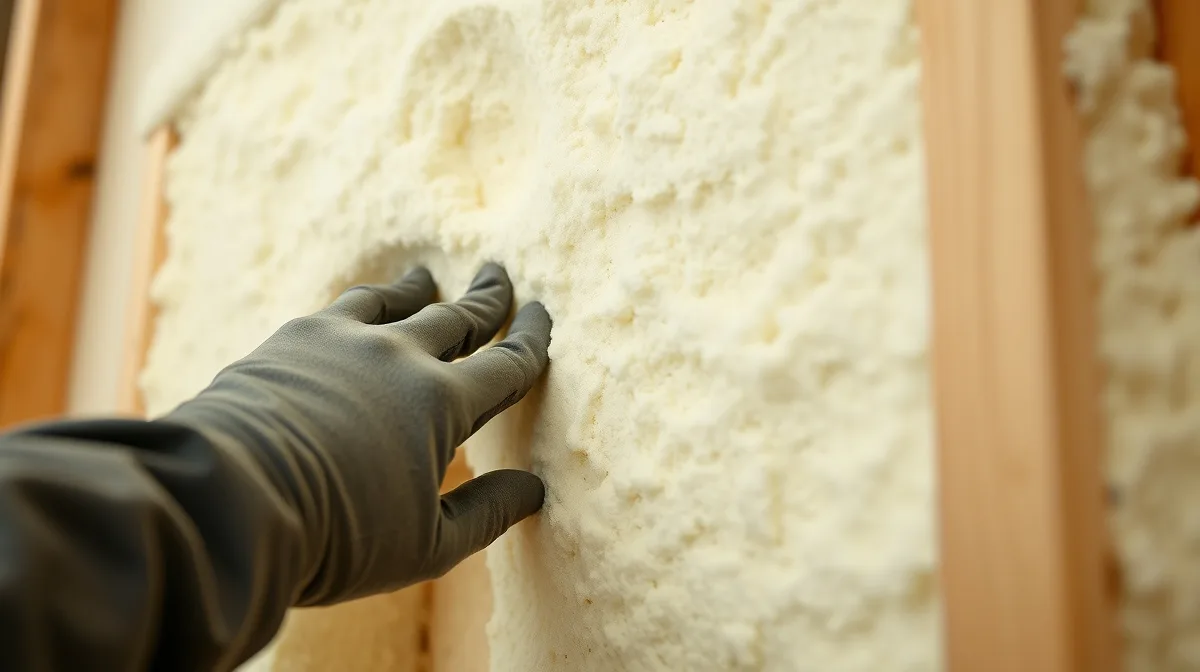
Open-cell spray foam is a lower-density polyurethane foam that expands to roughly 100 times its liquid volume once applied, filling stud bays, roof deck cavities, and irregular framing gaps far more completely than batt insulation ever can. It runs about R-3.5 to R-3.7 per inch, lower than closed-cell foam, but it costs less installed and its soft, flexible cell structure makes it the right call for a specific set of applications rather than a downgrade from closed-cell. We install it as a dedicated product, not a cut corner.
Because open-cell foam is vapor-permeable rather than a vapor barrier, it lets wall and roof assemblies dry the way they were designed to, which matters in interior applications where trapping moisture behind an impermeable layer can create problems instead of solving them. That permeability, combined with its expansion characteristics and sound-dampening density, is why we spec it for interior partition walls, underside-of-roof-deck attic conversions, and any cavity with irregular framing, wiring, or plumbing runs that would leave gaps in a batt install. We install this nationwide for homeowners, builders, and property owners who want a single-application product that insulates and air-seals in one pass.
Why property owners choose it
- Expands aggressively to fill irregular stud bays, odd angles, and framing obstructed by wiring or plumbing that batts and rigid boards can't fully surround.
- Air-seals every gap and penetration it fills, stopping the drafts and air leakage that fiberglass and cellulose simply lay on top of.
- Costs less per square foot installed than closed-cell foam, making it a practical choice for larger interior volumes like full attics and multi-room wall cavities.
- Delivers meaningfully better sound dampening between interior rooms, floors, and shared walls than either closed-cell foam or standard batt insulation.
- Stays vapor-permeable so wall and roof assemblies can still dry properly instead of trapping moisture behind an impermeable layer.
- Cures into a stable, lightweight fill that won't settle, sag, or compress out of the cavity the way blown-in insulation can over time.
Where Open-Cell Foam Belongs in a Building
Open-cell foam earns its place in interior conditions, not exterior or below-grade ones. It's our default recommendation for interior stud walls between rooms, unvented attics sprayed at the roof deck, and any cavity where the priority is filling every irregular gap in a single pass rather than building a moisture barrier. Its low density lets it expand into spaces that closed-cell foam, applied at a controlled thickness, would leave partially unfilled.
That same low density is why we don't spec open-cell for crawl space walls, rim joists, or exterior applications near grade. Those locations need a product that also blocks bulk moisture, and open-cell simply isn't built for that job. Matching the foam type to the location is the difference between a spray foam job that performs for decades and one that creates callbacks, so every estimate starts with an honest look at which cavities actually call for open-cell versus closed-cell.
- Interior partition and demising walls between conditioned rooms
- Unvented attics sprayed at the underside of the roof deck
- Vaulted and cathedral ceiling cavities with irregular rafter framing
- Interior soffits and framed-out mechanical chases
The Sound-Dampening Advantage
Most homeowners call about energy performance and discover the sound-dampening benefit almost by accident once the job is done. Open-cell foam's expanded, semi-rigid cell structure absorbs airborne sound far more effectively than an empty stud bay or a loosely-fitted batt, which is why it shows up so often in home theaters, home offices, nurseries, and shared walls between units in multi-family construction.
This isn't a marketing add-on — it's a direct consequence of how the material fills a cavity. Because it expands to contact framing on every side with no voids, it interrupts sound transmission paths that a batt, which relies on friction-fit and inevitably leaves small gaps, cannot fully close. For builders and remodelers working on media rooms, offices, or bedroom walls adjacent to noisy areas of a house, we price open-cell interior wall spraying as its own line item separate from the whole-house energy package.
- Interior office and home-theater walls
- Nursery and bedroom walls adjacent to living areas
- Shared walls in duplexes and multi-family construction
- Mechanical room walls to dampen HVAC and equipment noise
What Vapor Permeability Means for Your Home
Open-cell foam is vapor-permeable, meaning water vapor can pass through it rather than being blocked outright. In interior applications, that's an advantage — it lets the wall or roof assembly manage moisture and dry in whichever direction the building science calls for, instead of trapping vapor behind a sealed layer where it has nowhere to go. This is a deliberate property, not a limitation of the product.
It does mean open-cell isn't the right choice anywhere bulk water or high ambient humidity is a real risk, which is why we pair it with a separate vapor retarder when local code or the specific assembly requires one, and why we default to closed-cell foam in crawl spaces, basements, and exterior applications near grade. Every open-cell estimate includes a straightforward explanation of whether your specific application needs an added vapor retarder, so there are no surprises after installation.
Ideal for
- Interior partition walls where sound dampening between rooms matters as much as thermal performance.
- Unvented attic conversions sprayed to the underside of the roof deck, bringing the attic into conditioned space.
- Cavities with irregular framing, angled rafters, or dense wiring and plumbing runs that need a foam that expands around obstructions.
- Interior applications where vapor permeability is preferred over a sealed vapor barrier, letting the assembly dry naturally.
- Larger-volume residential and light-commercial jobs where budget favors a lower installed cost per square foot than closed-cell.
What affects the cost
Open-Cell Foam questions, answered
Open-cell foam is softer, lighter, and less expensive at roughly R-3.5 to R-3.7 per inch, while closed-cell is dense and rigid at R-6 to R-7 per inch and doubles as a vapor and air barrier. Open-cell is the better fit for interior walls and attic roof decks; closed-cell is better for crawl spaces, rim joists, and exterior applications near moisture.
Yes, when it's sprayed to the underside of the roof deck to create an unvented, conditioned attic — this is one of the most common and cost-effective open-cell applications we install. It's less suited to attic floors in humid climates without an added vapor strategy, which your estimate will address.
In most living spaces and some attic applications, code requires open-cell foam to be covered with an approved thermal or ignition barrier, such as drywall or an intumescent coating, when it's left exposed. Our crews confirm the exact requirement for your specific space during the estimate so nothing gets missed at inspection.
No — open-cell foam is vapor-permeable, which means moisture can pass through it and the assembly can still dry rather than getting sealed in behind an impermeable layer. That's why we use it for interior applications and reserve closed-cell foam, which acts as its own vapor barrier, for locations closer to moisture and grade.
Open-cell foam expands to fill a cavity completely with no gaps or voids, which interrupts airborne sound transmission far more effectively than a friction-fit batt that never seals a stud bay perfectly. It's a common upgrade for home theaters, offices, nurseries, and shared walls where noise control matters as much as R-value.
Open-Cell Foam done right, by a dedicated spray foam crew
Open-Cell Foam isn't a commodity — the result depends entirely on how carefully it's planned and applied for your specific space. We assess what your project actually needs, prep the area properly, and apply to the depth and product your goals require, so the work delivers the comfort and savings it's supposed to. No shortcuts, no builder-grade rush.
We serve homeowners, builders and general contractors, and commercial property owners nationwide. Every job starts with a free, no-pressure assessment.
Just as important, we treat your building as a system. Air-sealing, insulation product choice, and ventilation all interact — getting one right while ignoring the others leaves comfort and savings on the table. When we scope your open-cell foam, we look at how it fits the whole picture, so the finished result performs the way it should and actually lowers the bills you feel every month.
Free assessment
We evaluate your space and give you a clear, itemized quote with no pressure.
Expert application
We prep and spray your open-cell foam to spec — clean and on schedule.
Comfort you can feel
A more comfortable, energy-efficient space and honest advice on what your project needs.
Related services
Ready for a free open-cell foam quote?
Tell us about your project and we'll put together a clear, no-pressure spray foam insulation quote — residential or commercial, anywhere in the country.