Rim Joist & Band Joist Insulation
The rim joist — also called the band joist — is the band of framing that runs around your home's entire perimeter where the foundation meets the first floor, and it's one of the most commonly under-sealed parts of the building envelope. We close it with closed-cell spray foam in a fast, focused visit that pairs naturally with crawl space or basement work.
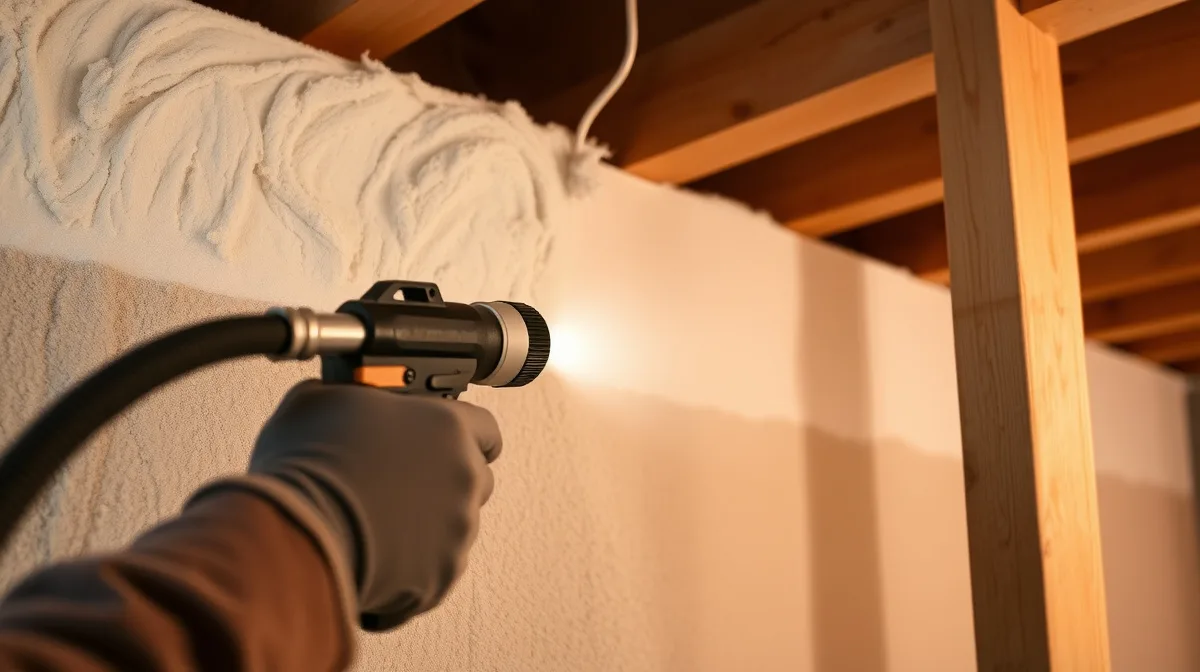
Every home built above a crawl space or basement has a band of wood framing running around the entire perimeter where the foundation meets the first-floor framing — the rim joist, also called the band joist. It's a narrow strip, usually just the depth of a floor joist, but it wraps the whole footprint of the house and sits at one of the most complicated transitions in the entire structure: wood framing meeting concrete or masonry foundation, dozens of individual joist bays, and every plumbing, electrical, and HVAC penetration that runs from the crawl space or basement up into the living space. Builders typically stuff each bay with a cut piece of fiberglass batt and move on, because code minimums are usually satisfied by R-value alone. But fiberglass batts don't air-seal anything — they sit loosely in an irregular cavity full of gaps, and outside air moves through, around, and past them freely. On most homes we inspect, the rim joist is one of the single largest sources of uncontrolled air infiltration in the entire building envelope, often rivaling or exceeding attic air leakage.
Spray foam solves this the same way it solves every air-sealing problem: it expands into full contact with the framing, fills every gap around plumbing and wiring penetrations, and cures into a continuous air barrier that also insulates at the same time. Because rim joist bays sit close to the ground, close to seasonal moisture, and directly against the concrete or masonry foundation, we install closed-cell spray foam here in the overwhelming majority of jobs — it resists moisture, adds rigidity to a structurally important band of framing, and doesn't require a separate vapor barrier. This is a national service: we spray rim joists on homes with crawl spaces, homes with basements, and new-construction framing before it's closed in, regardless of what part of the country the house sits in. Unlike a full attic or whole-house job, rim joist work is narrow in scope and fast to complete, which makes it one of the highest-return small jobs a homeowner or builder can schedule — especially when it's added onto a crawl space or basement project that's already underway.
Why property owners choose it
- Closed-cell spray foam air-seals every joist bay along the home's perimeter in a single application, closing a leak path that fiberglass batts never actually stop.
- The same application adds meaningful R-value to a section of the envelope that's often left as one of the weakest links in the whole house.
- Closed-cell foam adds rigidity and structural stiffening to the rim joist band, which is a load-bearing transition between the foundation and the first floor.
- Because the scope is narrow — a strip of framing rather than an entire attic or wall system — most rim joist jobs are completed in a matter of hours, not days.
- Sealing the band joist reduces cold floors, drafty baseboards, and uneven first-floor temperatures that traditional batt insulation never fully resolves.
- It's one of the highest-ROI improvements available for the labor and material involved, and it pairs naturally with a crawl space or basement job our crews are already on site for.
What the Band Joist Is and Why It Leaks So Much
The band joist sits directly on top of the foundation's sill plate and forms the outer edge of the floor system — every floor joist in the house ties into it. That geometry alone makes it one of the hardest parts of a house to insulate correctly. Each joist bay is a separate, irregularly-shaped cavity, and the transition from wood framing to concrete or masonry foundation is never perfectly flat or airtight. Add in the plumbing stacks, electrical wiring, dryer vents, and HVAC penetrations that commonly route through this band, and you end up with dozens of individual gaps circling the entire perimeter of the house. A stuffed fiberglass batt covers the opening visually but does nothing to stop air from moving through the gaps around it, which is why this area shows up so often on blower-door tests and thermal scans as a major leak source.
This is also why a rim joist that looks insulated on a quick walkthrough can still be leaking heavily. A batt can be sitting neatly in every bay and still leave gaps around its edges, at seams between joists, and anywhere it doesn't fully compress into the cavity. Blower-door testing and infrared cameras routinely find this area glowing with cold air infiltration even in homes that technically meet code minimums for insulation. Spray foam is the only common material that closes those edge gaps completely, because it expands to fill the irregular shape of the cavity rather than being cut to an approximate size and pushed into place.
- Sill plate-to-foundation transition — rarely airtight even on newer builds
- Individual floor joist bays — each one a separate gap-prone cavity
- Plumbing, electrical, and HVAC penetrations routed straight through the band
- Rough or irregular framing that fiberglass batts can't conform to
How We Insulate and Air-Seal the Rim Joist
Rim joist work is done from whichever side gives the best access — inside a crawl space, inside a basement, or from the exterior during new-construction framing before the wall system closes in. Crews first clear out any existing fiberglass batts and inspect each bay for penetrations, moisture staining, or framing damage that needs to be addressed before foam goes in. We then spray closed-cell foam directly into each joist bay, building it up to the thickness needed to meet or exceed the R-value target for that band of the envelope. Closed-cell foam expands modestly and sets within seconds, so crews can move steadily around the entire perimeter in one continuous pass rather than working bay by bay over multiple visits. A final walk-through checks for full, even coverage and confirms every penetration and gap along the band is sealed.
Thickness targets follow the same R-value guidance used for the rest of the home's insulation plan, and crews confirm coverage bay by bay rather than estimating from a distance. On new construction, this work happens before subfloor, drywall, or exterior finishes go on, which is the only point where the band joist is ever fully open and accessible again. On existing homes, crawl space or basement access is usually sufficient without any demolition, which is part of why rim joist work stays fast and low-disruption compared to most other insulation upgrades.
- Remove or trim back existing fiberglass batts
- Inspect for moisture, pests, or framing issues before spraying
- Apply closed-cell foam to each joist bay at the required thickness
- Seal around plumbing, wiring, and vent penetrations as part of the same pass
- Final coverage check along the full perimeter
Why This Pairs So Well With Crawl Space or Basement Work
Because the band joist sits right at the top of the crawl space or basement wall, it's almost always in the same work zone as a crawl space encapsulation or basement insulation project — which is why we build it into those jobs as standard scope rather than a separate add-on whenever possible. If crews are already down there sealing crawl space walls or basement rim areas, extending closed-cell foam up and across every joist bay adds relatively little time to the visit but closes off one of the last major gaps in that part of the building envelope. Homeowners who've already had crawl space walls encapsulated but never had the band joist addressed are one of the most common callbacks we get, and it's usually a fast fix once we're on site.
That said, we also treat rim joist insulation as a fully standalone service for homeowners who only want this one detail addressed — it doesn't require committing to a full encapsulation project to get value out of the work. For builders and remodelers, sealing the band joist is also one of the easiest wins to fold into a broader energy-code compliance push, since it's inexpensive relative to its impact on the whole-house air-sealing number. Either way, the goal is the same: close the gap between foundation and first floor for good.
Ideal for
- Homes with an unfinished or vented crawl space where the band joist is exposed and easy to access.
- Basements where fiberglass batts have sagged, fallen out of the joist bays, or were never properly air-sealed in the first place.
- Homeowners noticing cold floors, drafts near baseboards, or higher-than-expected heating bills in a single-story-over-crawl-space or basement-level home.
- New-construction builds where the rim joist can be sealed and insulated before it's closed in behind subfloor and finish materials.
- Anyone already scheduling a crawl space encapsulation or basement insulation project who wants the perimeter band joist addressed in the same visit.
What affects the cost
Rim Joist Insulation questions, answered
They're two names for the same framing member — the band or rim joist is the piece of lumber that sits on top of the foundation's sill plate and caps the ends of the floor joists around the entire perimeter of the house. Different trades and regions use the terms interchangeably, but they're describing the same detail.
It combines dozens of individual, irregularly-shaped joist bays with a wood-to-foundation transition that's rarely airtight, plus plumbing, wiring, and vent penetrations running straight through it. Fiberglass batts stuffed into that space insulate a little but don't stop air movement, so it consistently shows up as one of the largest leak points on a home.
In almost every case, yes — closed-cell foam resists moisture at a spot that sits close to the ground and directly against the foundation, and it adds rigidity to a structurally important band of framing. Open-cell is occasionally used in dry, well-ventilated conditions, but closed-cell is the standard recommendation here.
Yes — rim joist insulation is a legitimate standalone service on its own, since it's a narrow, well-defined scope of work. It's just as commonly bundled with a crawl space encapsulation or basement job when both are already on the table.
Most homes are completed in a few hours, since the scope is limited to a single band of framing around the perimeter rather than an entire attic, wall system, or whole house. Exact timing depends on total linear footage and how easy the crawl space or basement is to access.
Rim Joist Insulation done right, by a dedicated spray foam crew
Rim Joist Insulation isn't a commodity — the result depends entirely on how carefully it's planned and applied for your specific space. We assess what your project actually needs, prep the area properly, and apply to the depth and product your goals require, so the work delivers the comfort and savings it's supposed to. No shortcuts, no builder-grade rush.
We serve homeowners, builders and general contractors, and commercial property owners nationwide. Every job starts with a free, no-pressure assessment.
Just as important, we treat your building as a system. Air-sealing, insulation product choice, and ventilation all interact — getting one right while ignoring the others leaves comfort and savings on the table. When we scope your rim joist insulation, we look at how it fits the whole picture, so the finished result performs the way it should and actually lowers the bills you feel every month.
Free assessment
We evaluate your space and give you a clear, itemized quote with no pressure.
Expert application
We prep and spray your rim joist insulation to spec — clean and on schedule.
Comfort you can feel
A more comfortable, energy-efficient space and honest advice on what your project needs.
Related services
Ready for a free rim joist insulation quote?
Tell us about your project and we'll put together a clear, no-pressure spray foam insulation quote — residential or commercial, anywhere in the country.