Open-Cell vs. Closed-Cell Spray Foam: Which Is Right for Your Project?

Every spray foam quote eventually comes down to one question: open-cell or closed-cell? Both are polyurethane spray foams. Both insulate and air-seal in a single application, which is more than fiberglass or cellulose can do. But the two products are chemically different, and that difference changes how they perform in every category that matters — R-value, cost, moisture handling, structural contribution, and even how much noise they block. Picking the wrong one for the application doesn't just waste money; it can create a moisture problem where none existed. Here's how the two actually compare, and where each one belongs.
The Basic Difference: Cell Structure
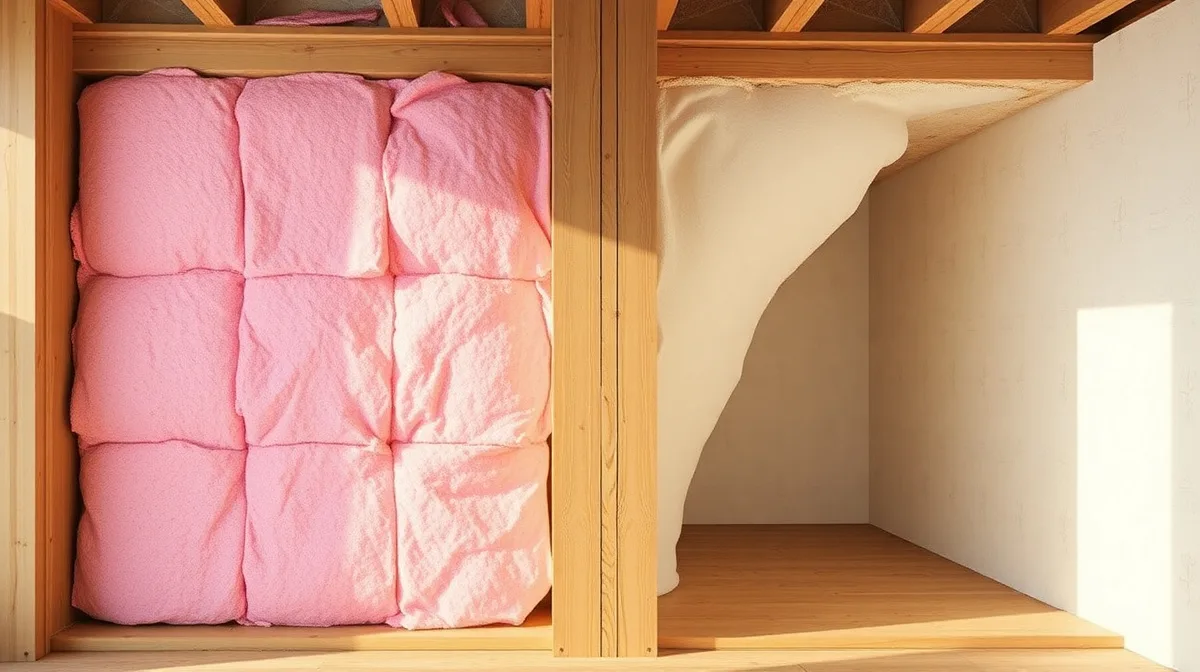
The name gives it away. Open-cell foam is manufactured with cells that stay open and interconnected, which makes the cured foam soft, spongy, and light — roughly 0.5 lb per cubic foot. It expands aggressively during application, often 100 times its liquid volume, which lets it fill irregular stud bays and odd framing without much waste. Closed-cell foam uses a blowing agent that keeps the cells sealed shut, packing them tightly together into a rigid, dense material — typically 1.75 to 2.2 lb per cubic foot. It expands far less (usually 30 to 40 times its liquid volume), so it's applied in metered lifts to hit a target thickness rather than sprayed to fill a cavity in one pass. That structural difference at the cell level is the reason every other comparison in this article breaks the way it does.
R-Value Per Inch
R-value measures resistance to heat flow, and it's the number most homeowners fixate on — for good reason, since it drives how thick a cavity needs to be sprayed to hit a performance target. Closed-cell spray foam delivers roughly R-6 to R-7 per inch, the highest R-value per inch of any common insulation material on the market. Open-cell lands around R-3.5 to R-3.7 per inch — lower than closed-cell, but still ahead of fiberglass batts (about R-2.9 to R-3.8 per inch, and that's before accounting for real-world performance loss from air gaps, compression, and settling) and blown cellulose (roughly R-3.2 to R-3.8 per inch, which also settles over time). In practice, this means closed-cell can hit a high R-value target in a shallower cavity — useful in a 2x4 wall or a tight rim joist bay — while open-cell typically needs a full stud-bay depth to reach the same performance level as fiberglass at a fraction of the thickness closed-cell would require.
Density, Rigidity, and Racking Strength
This is where the two products diverge the most, and it's often overlooked in a pricing conversation. Open-cell foam stays soft and pliable after curing — it insulates and air-seals, but it doesn't add meaningfully to a structure's rigidity. Closed-cell foam cures rock-hard and bonds tightly to framing, studs, and sheathing, and in doing so it adds real racking strength to a wall assembly — resistance to the lateral, twisting forces wind and seismic loads place on a structure. Builders in high-wind regions or anyone reinforcing an older wall assembly often specify closed-cell partly for this reason, not R-value alone. It's a structural bonus that open-cell simply doesn't offer.
Vapor Permeability and Moisture Behavior
Open-cell foam is vapor-permeable — it lets water vapor pass through it rather than blocking it, which means it is not a moisture barrier and needs to be paired with a separate vapor retarder in some assemblies and climates. Closed-cell foam is effectively its own vapor barrier and air barrier once it's a couple of inches thick, which is exactly why it's the standard choice anywhere moisture is a real risk — crawl space walls, rim joists, exterior wall sheathing, and below-grade applications. Spraying open-cell foam directly against a cold exterior wall or a damp crawl space surface without the right vapor strategy is one of the more common mistakes in this trade, and it's a large part of why the two products aren't interchangeable just because both are technically "spray foam."
Cost Comparison
Open-cell foam is the less expensive option, typically running $1.50 to $3.50 per square foot installed. Closed-cell runs higher, typically $3.00 to $5.00 per square foot installed, reflecting both the higher material cost and the greater R-value it delivers per inch. For a full attic project, that translates to roughly $3,000 to $5,000 for a typical 1,000 sq ft attic with open-cell, versus $4,500 to $7,000 for the same attic in closed-cell. These are national starting-point ranges, not fixed prices — access difficulty, target thickness, and total square footage all move the number, which is why a firm quote always comes from an on-site or photo-based estimate rather than a rule of thumb.
Sound-Dampening Differences
If noise reduction is part of the goal — a home office, a media room, a shared wall between units — open-cell has a real advantage. Its soft, open structure absorbs airborne sound noticeably better than closed-cell's dense, rigid structure, which reflects sound more than it absorbs it. Interior partition walls sprayed for sound control almost always use open-cell for this reason, even in projects where closed-cell is used elsewhere in the building for its R-value or moisture properties.
Best Use by Application
Attics
Both products are used in unvented, conditioned attic conversions, spraying the underside of the roof deck. Open-cell is common because it fills deep rafter bays economically and the attic isn't typically exposed to bulk moisture the way a crawl space is. Closed-cell is chosen when roof-deck condensation risk is a concern or when cavity depth is limited.
Walls
Interior and standard exterior wall cavities in most climates work well with open-cell for cost efficiency and sound-dampening, while closed-cell is favored on exterior walls facing harsh climates, near grade, or wherever the added racking strength and air/vapor barrier are worth the premium.
Crawl Spaces
Closed-cell is the standard here, applied to crawl space walls as part of a full encapsulation approach. Its moisture resistance and air-barrier properties are exactly what a damp, ground-adjacent space needs — open-cell's vapor permeability makes it a poor fit for this application.
Rim Joists / Band Joists
Closed-cell is almost always the right call at the rim joist — the perimeter band between foundation and first floor, one of the largest uncontrolled air-leak points in most homes. The tight cavity depth and moisture exposure at this detail both favor closed-cell's density and vapor-barrier performance over open-cell's greater expansion and lower cost.
The short version: closed-cell wins on R-value per inch, structural contribution, and moisture control; open-cell wins on upfront cost and sound-dampening. Most whole-home projects actually use both — closed-cell where moisture or structure matters, open-cell everywhere else. A licensed crew can walk your specific project and tell you exactly where each one belongs before you commit to either.
Frequently asked questions
Yes, and it's common. Many projects use closed-cell at the rim joist, crawl space walls, or below-grade areas for moisture control and structural strength, then use open-cell in interior walls or attic rafters where cost efficiency and sound-dampening matter more than a moisture barrier.
Not necessarily. Closed-cell costs more per square foot, and its rigidity and vapor-barrier properties aren't needed everywhere. Open-cell often makes more sense for interior partition walls or large attic rafter cavities where budget and sound control matter more than squeezing maximum R-value into minimal thickness.
Open-cell spray foam is the better choice for sound dampening. Its soft, open cell structure absorbs airborne sound more effectively than closed-cell's dense, rigid structure, which is why interior walls sprayed specifically for noise reduction typically use open-cell.
Yes. Closed-cell foam cures rigid and bonds tightly to framing and sheathing, adding measurable racking strength that helps a wall assembly resist lateral wind and seismic loads. Open-cell stays soft after curing and doesn't provide this structural benefit.
Ready for a free quote?
Tell us about your project and we'll build a clear, no-pressure quote.