Spray Foam vs. Fiberglass vs. Cellulose: Comparing Insulation R-Value and Performance
Every insulation product gets sold on an R-value number, and it's tempting to treat that number as the whole story. It isn't. R-value per inch tells you how well a material resists heat flow through itself, but it says nothing about how much air is leaking around it, how it holds up over years in a real building, or what happens to it if moisture gets involved. Spray foam, fiberglass, and blown cellulose are the three materials homeowners and builders compare most often, and each performs differently across all four categories. Here's a straight comparison of how they stack up.
R-Value Per Inch: The Baseline Comparison
Per inch of material, the R-value spread across these three products is real and worth understanding before you compare project costs. Closed-cell spray foam runs roughly R-6 to R-7 per inch, the highest of any commonly used insulation material. Open-cell spray foam runs about R-3.5 to R-3.7 per inch — lower than closed-cell, but still competitive with the other two materials while expanding to fill irregular cavities more completely. Fiberglass batts land around R-2.9 to R-3.8 per inch on paper, and blown cellulose is similar at roughly R-3.2 to R-3.8 per inch.
- Closed-cell spray foam: ~R-6 to R-7 per inch
- Open-cell spray foam: ~R-3.5 to R-3.7 per inch
- Fiberglass batts: ~R-2.9 to R-3.8 per inch (as-installed, before real-world losses)
- Blown cellulose: ~R-3.2 to R-3.8 per inch (before settling losses)
Closed-cell foam needs roughly half the cavity depth of fiberglass or cellulose to hit the same R-value — an advantage in rim joists, cathedral ceilings, and other tight spaces. But the "as-installed" numbers for fiberglass and cellulose are almost always lower than the lab number, because both are vulnerable to a problem R-value testing doesn't capture: air movement.
Air-Sealing: The Difference Insulation Alone Can't Fix
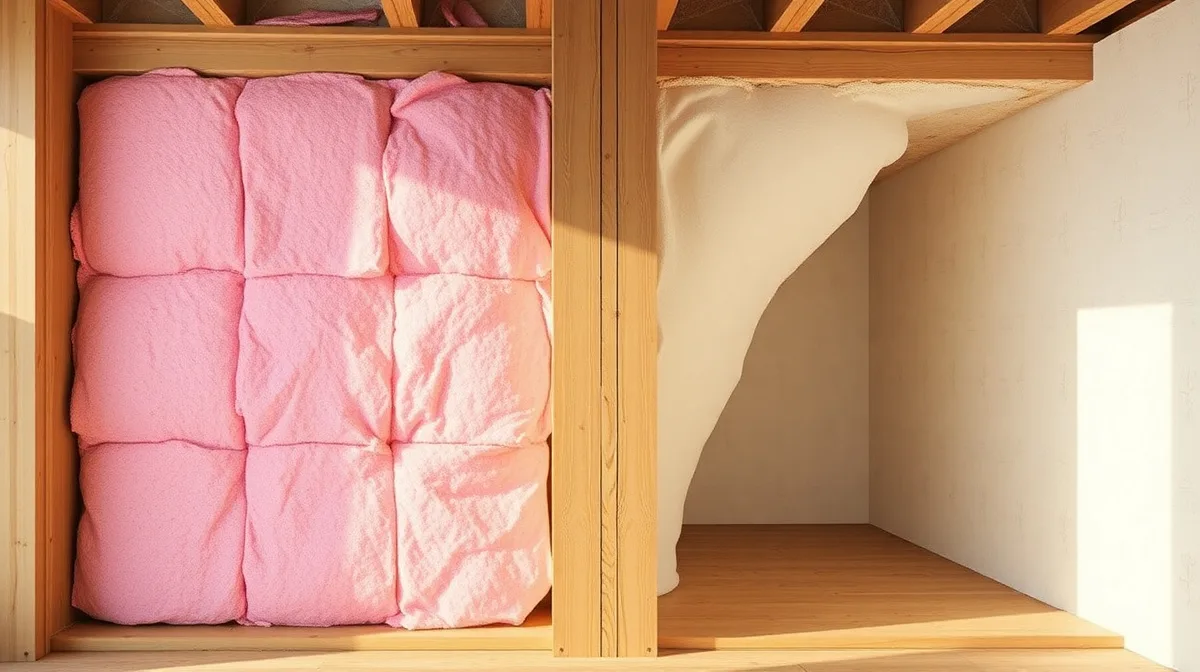
This is the core distinction between spray foam and traditional insulation. Spray foam insulates and air-seals in a single application — as it expands, it fills gaps, cracks, and penetrations around wiring, plumbing, and framing, creating a continuous air barrier at the same time it's building R-value. Fiberglass and cellulose do neither on their own. Both slow heat transfer through conduction, but they simply lay in or get blown into a cavity — they don't seal the gaps around electrical boxes, top plates, duct penetrations, or the small air paths that let conditioned air escape.
In most homes, uncontrolled air leakage accounts for a large share of total energy loss — often more than straight heat conduction through under-insulated cavities. A wall filled with high-R-value fiberglass batts can still perform poorly if it's full of air gaps the batts weren't installed tightly enough to block, or if the batts were compressed around wiring and outlets (which lowers real R-value on the spot). Spray foam's expanding application removes that installation-quality variable almost entirely.
Settling and Degradation Over Time
Blown cellulose settles. Over time, gravity and vibration compact the material in wall cavities and attics, reducing its installed depth — and its effective R-value — below what was originally installed. Manufacturers account for this with settled-density fill charts, but it's a known long-term performance loss that doesn't show up on day one. Fiberglass batts don't settle the same way, but they lose performance differently: batts that shift, sag, or get compressed over time — or were never cut tightly to fit irregular cavities in the first place — leave gaps that reduce real-world R-value well below the rated number, and that gap tends to widen with age.
Properly installed spray foam doesn't settle. Once cured, it's a rigid or semi-rigid material bonded to the substrate — it holds its shape, depth, and R-value for the life of the building envelope rather than degrading year over year. Traditional insulation's real-world performance tends to drift downward from installation day; correctly installed spray foam's performance stays effectively flat.
Moisture Behavior
Moisture is where these materials diverge the most. Fiberglass and cellulose are both vapor-permeable and can absorb moisture if they get wet — from a roof leak, condensation, or humidity intrusion — which reduces their insulating value while wet and can promote mold growth in the surrounding framing if the moisture isn't dealt with quickly. Cellulose in particular can hold water for a long time once saturated, since it's a dense, absorbent material by design.
Closed-cell spray foam behaves differently: its dense structure makes it largely resistant to water absorption, and it can function as its own vapor barrier — an advantage in crawl spaces, rim joists, and other areas prone to moisture exposure. Open-cell foam is vapor-permeable rather than a moisture barrier, so it's typically not the first choice in consistently damp environments unless paired with the right vapor-control strategy. In moisture-prone areas, material choice isn't just about R-value — it's about which product holds up when water shows up.
Installed Cost vs. Long-Term Energy Savings
Fiberglass and cellulose cost less upfront than spray foam per square foot, and that gap is real. But installed cost is only half the picture. Because spray foam air-seals as it insulates, homes and buildings treated with it typically see reduced heating and cooling loads compared to the same structure insulated with fiberglass or cellulose alone — smaller drafts, less HVAC run time, and more stable indoor temperatures translate into lower ongoing energy bills. Spray foam installed nationwide typically runs $1.50-$5.00 per square foot depending on type, with open-cell in the $1.50-$3.50 range and closed-cell in the $3.00-$5.00 range; a typical attic project runs $2,500-$7,500. Traditional insulation costs less to install, and the tradeoff is straightforward: a lower upfront number against a slower path to the air-sealing benefit that drives most long-term savings. Utility rebate programs sometimes offset either option — check current program details before assuming a specific dollar figure.
When Traditional Insulation Still Makes Sense
Spray foam isn't the right call for every project. Fiberglass and cellulose remain reasonable choices in several situations:
- Budget-constrained retrofits where upfront cost is the deciding factor and air-sealing gets addressed separately with caulk and weatherstripping
- Code-minimum builds where the goal is meeting the required R-value at the lowest material cost
- Large open cavities like uninsulated attic floors, where low cost per square foot matters more than compressing insulation into a shallow space
- Projects where a fast, low-disruption install matters more than long-term settling performance
- Sound-dampening-only interior partition walls where thermal performance isn't the primary goal
The honest framing: traditional insulation still does one job well — slowing conductive heat transfer at a lower material cost. Spray foam does that same job at a higher R-value per inch, plus a second job — air-sealing — that fiberglass and cellulose can't do at all. Which material makes sense depends on budget, moisture exposure, cavity depth, and how much of the building's energy loss is coming from air leakage versus conduction. A firm answer for a specific property is best settled with a free on-site estimate rather than a general rule of thumb.
Frequently asked questions
It's a real, measurable difference, not just a marketing claim. Spray foam has a higher R-value per inch than fiberglass or cellulose, and unlike either traditional material, it air-seals as it insulates. Fiberglass and cellulose only slow heat transfer — they don't stop air leakage, which is a major source of energy loss in most buildings.
Yes, both typically lose some real-world performance over time. Blown cellulose settles and compacts, reducing its effective depth and R-value below the original installed number. Fiberglass batts can sag, shift, or develop gaps around framing and penetrations, which lowers real-world performance even though the material itself doesn't degrade chemically. Properly installed spray foam doesn't settle and holds its R-value over the life of the building envelope.
Closed-cell spray foam performs best in moisture-prone areas — it's largely water-resistant and can act as its own vapor barrier, which is why it's the standard choice for crawl spaces and rim joists. Fiberglass and cellulose are both vapor-permeable and can absorb moisture if they get wet, which reduces their insulating value and can contribute to mold risk in surrounding framing if not addressed quickly.
Ready for a free quote?
Tell us about your project and we'll build a clear, no-pressure quote.